

Why Hair Loss Happens and What You Can Do About It

More hair on your pillow. Clumps in the shower drain. A part that looks wider than it used to.
If any of that sounds familiar, take a breath. You are not alone, and in most cases, this is something you can work with. The majority of shedding and thinning is not permanent, and the people who see the best results are the ones who stop guessing and start understanding what is actually going on. That is what this guide is for.
Why Hair Loss Feels Sudden
Your hair grows in cycles. Most scalp hairs spend years actively growing (a phase called anagen), then briefly rest (catagen), before naturally shedding (telogen). At any given time, the vast majority of your hair is in the growth phase, while a smaller percentage is resting or shedding.
When something disrupts that cycle, the effects are not immediate. The most common disruption has a name worth knowing: telogen effluvium. A stressor pushes more hairs than usual into the resting phase all at once, but the visible shedding typically begins two to three months later.
That delay is why so many people feel blindsided. The trigger already happened. They just had not seen the result yet.
It also helps to understand that not all hair loss looks the same:
- Shedding means more hairs are falling out than usual, often from all over the scalp
- Thinning means hair is growing back finer or less densely over time
- Breakage means the strand is snapping from damage, while the follicle itself may be fine
These three things look similar at first, but they point to very different causes. The pattern matters more than the panic.
Telogen effluvium is considered one of the most common causes of diffuse hair shedding, with many adults experiencing at least one episode in their lifetime. The hallmark feature is a 2-to-3-month delay between the triggering event and the onset of noticeable shedding, which aligns with the normal duration of the telogen resting phase.
The Most Common Types
Not all hair loss is the same, and the pattern usually points you in the right direction. Here is a quick overview of the most common types:
| Type | What It Looks Like | Common Triggers |
|---|---|---|
| Telogen Effluvium | Diffuse shedding all over | Illness, stress, surgery, weight loss, hormonal changes |
| Androgenetic Alopecia | Widening part or thinning crown | Genetics, hormonal sensitivity |
| Alopecia Areata | Smooth, round bald patches | Autoimmune response |
| Traction Alopecia | Thinning at hairline or edges | Tight styles, braids, extensions |
| Scalp Inflammation | Thinning with itch, flaking, redness | Dermatitis, product buildup, irritants |
| Nutritional / Metabolic | Diffuse thinning, dull, brittle hair | Low iron, protein, vitamin D, thyroid |
"Most people who come to me worried about hair loss are actually dealing with a temporary shedding pattern. That distinction changes everything about how we approach the situation."
Tina Mui, Certified Trichologist
Get the Complete 4R Protocol
Enter your email to unlock our trichologist's framework for supporting hair recovery, plus ongoing scalp health insights.
No spam. Unsubscribe anytime.

The 4R Scalpcare Protocol
Here is the uncomfortable truth: most haircare routines are actively working against your scalp.
The majority of shampoos on the market rely on silicones, synthetic fragrances, and coating agents that leave residue on the scalp, clog follicles, and irritate the barrier over time. Conditioners load on heavy coatings to make hair feel smooth, but those same coatings suffocate the scalp underneath.
Even products marketed as "scalp care" often contain ingredients that create short-term relief while making the underlying environment worse.
If you are losing hair and your routine is built around these kinds of products, your scalp may not be getting what it actually needs.
Think of scalp health the way you think about fitness. A consistent routine does not guarantee you will never have issues, but it makes your body significantly more resilient. The 4R Protocol is a framework Tina developed over 40 years of trichology practice, a structured daily routine that keeps your scalp in the best condition for growing strong, healthy hair.
Step 1: Reset
Purify the scalp of buildup that can suffocate follicles and irritate the barrier. Focus shampoo on the scalp (not the lengths), add water and emulsify longer than you think, and consider double-cleansing, especially after heavy exposure days like workouts, pool visits, or time in polluted air.
- Skip harsh scrubs, plastic scalp brushes, and shampooing with your nails
- Avoid hot water, which can worsen sensitivity
- Do not try to "train your hair" by skipping washes when the scalp needs cleansing
Step 2: Repair
Restore moisture and nourishment so the scalp can regulate itself again. Choose products with active ingredients that support barrier health and reduce inflammation.
- Dual-weight hyaluronic acid for deep molecular hydration at the scalp level
- Biofermented microalgae rich in essential lipids, peptides, and microbiome-balancing nutrients
- Antioxidants like green tea to calm inflammation and protect against oxidative stress
- Use a scalp mask or balancing conditioner 1-2 times per week
- Prioritize consistent routines over product cycling: the scalp responds to stability, not novelty
Step 3: Reinforce
Protect from the environmental stressors that damage the scalp barrier and follicles over time. Growth means nothing if the hair breaks before it becomes visible.
- Treat your scalp like an extension of your face: use a leave-in with UV protection
- Change your part occasionally to reduce repeated UV exposure in one line
- Wear loose styles and avoid tight ponytails, buns, or braids that pull on the hairline
- Sleep on silk or satin pillowcases to reduce friction, and never sleep on wet hair
- Pay attention to your environment: hard water minerals, air pollution, and UV exposure all stress the scalp barrier over time
Step 4: Reactivate
Stimulate circulation and help release tension that can keep the scalp inflamed or stagnant.
- Use a scalp gua sha or the pads of your fingers 3-5 times per week
- Move the skin with light-to-medium pressure, never scratch aggressively
- Focus on areas that feel tight or tender
This step is where many people notice the most tangible shift. Improved circulation helps deliver nutrients to the follicle and supports everything upstream in the protocol. Think of it as turning up the volume on all the work you are already doing.
If you are looking for products designed around this framework, here is how the AWARE line maps to each step:
| Step | What It Does | AWARE Product |
|---|---|---|
| Reset | Purifies the scalp without stripping the barrier | 9·1 Professional Shampoo |
| Repair | Restores moisture and supports barrier health | 9·1 Professional Conditioner |
| Reinforce | UV protection and daily barrier defense | 9·1 Professional Leave-In |
| Reactivate | Stimulates circulation and releases tension | Sandalwood Scalp Gua Sha |
What to Do First
If you are dealing with hair loss right now, try not to start with panic. Start with structure. Here are six steps that can bring clarity:
- Build your timeline. Write down when shedding started, then work backward three months. The trigger often happened well before the shedding became visible.
- Identify the pattern. Diffuse shedding? Widening part? Patchy spots? Hairline recession? The pattern narrows down what you may be dealing with.
- Reset your routine. If your scalp is irritated or overloaded, simplify. A gentle shampoo without SLS or SLES, no aggressive scrubs, no constant product-switching.
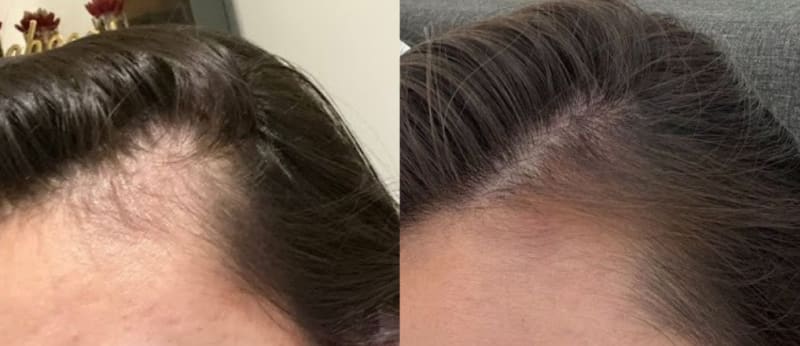
- Document with photos. Same lighting, every 2-4 weeks: front hairline, temples, center part, crown. Photos tell the truth more clearly than stress does.
High-dose biotin is heavily marketed for hair, but both the FDA and NIH note that biotin can interfere with certain lab tests. If you are considering supplements, start with bloodwork. What your body actually needs may be different from what is trending.
- Consider professional evaluation. A trichologist or dermatologist can examine the scalp, discuss timing and triggers, and order targeted lab work. Go sooner if shedding is severe, persistent beyond three months, or accompanied by scalp pain.
Recovery timelines vary by type. Most telogen effluvium cases show noticeable improvement within 6 to 12 months once the trigger is addressed. Androgenetic thinning requires ongoing, consistent management. In either case, patience and consistency matter far more than intensity.
A systematic approach to hair loss evaluation, including patient history, physical examination, and targeted laboratory testing, significantly improves diagnostic accuracy compared to empirical treatment alone. Identifying the underlying cause before beginning treatment leads to better outcomes and avoids unnecessary interventions.
Frequently Asked Questions
Is it normal to lose hair every day?
Yes. Most people shed between 50 and 100 hairs per day as part of the natural hair growth cycle. This is not considered hair loss. If you are consistently seeing significantly more than that, or noticing thinning, widening of the part, or patchiness, it may be worth investigating with a trichologist or dermatologist.
How do I know if my hair loss is temporary or permanent?
The pattern often tells you. Diffuse shedding that started after a stressor like illness, surgery, or rapid weight loss is usually temporary. Gradual thinning at the part or crown over months or years may indicate a progressive pattern that benefits from consistent, ongoing care. Sudden smooth patches suggest an immune-mediated condition that requires professional evaluation. When in doubt, see a dermatologist or trichologist.
Can scalp care actually help with hair loss?
Scalp care supports the environment where hair grows. A healthy, well-hydrated scalp with a functioning barrier creates better conditions for the follicle to produce stronger, more resilient hair. While scalp care alone may not reverse genetic hair loss, it can help reduce inflammation, remove buildup that clogs follicles, and support the health of the hair you are growing. Think of it as the foundation, not a standalone solution.
How long does it take for hair to grow back after shedding?
Hair grows approximately half an inch per month. After a telogen effluvium episode, regrowth typically becomes noticeable within 3 to 6 months once the underlying trigger has been resolved. Full density recovery can take 12 to 18 months. For progressive thinning patterns, consistent care over 6 to 12 months is usually needed before meaningful improvement becomes visible. Patience matters more than intensity.
What's Your Scalp Telling You?
You read about environmental stressors in the Reinforce step. UV, water hardness, and air quality vary by location, and they all affect scalp health. Get a complimentary report tailored to your zip code.
References
- Malkud S. "Telogen Effluvium: A Review." Journal of Clinical and Diagnostic Research. 2015;9(9):WE01-WE03.
- Olsen EA, et al. "Evaluation and treatment of male and female pattern hair loss." Journal of the American Academy of Dermatology. 2005;52(2):301-311.
- Grover C, Khurana A. "Telogen effluvium." Indian Journal of Dermatology, Venereology and Leprology. 2013;79(5):591-603.
- Trüeb RM. "The impact of oxidative stress on hair." International Journal of Cosmetic Science. 2015;37 Suppl 2:25-30.
- Mirmirani P, Huang KP, Price VH. "A practical, algorithmic approach to diagnosing hair shaft disorders." International Journal of Dermatology. 2011;50(1):1-12.
- Sinclair R. "Diffuse hair loss." International Journal of Dermatology. 1999;38 Suppl 1:8-18.
- Billero V, Miteva M. "Traction alopecia: the root of the problem." Clinical, Cosmetic and Investigational Dermatology. 2018;11:149-159.
